
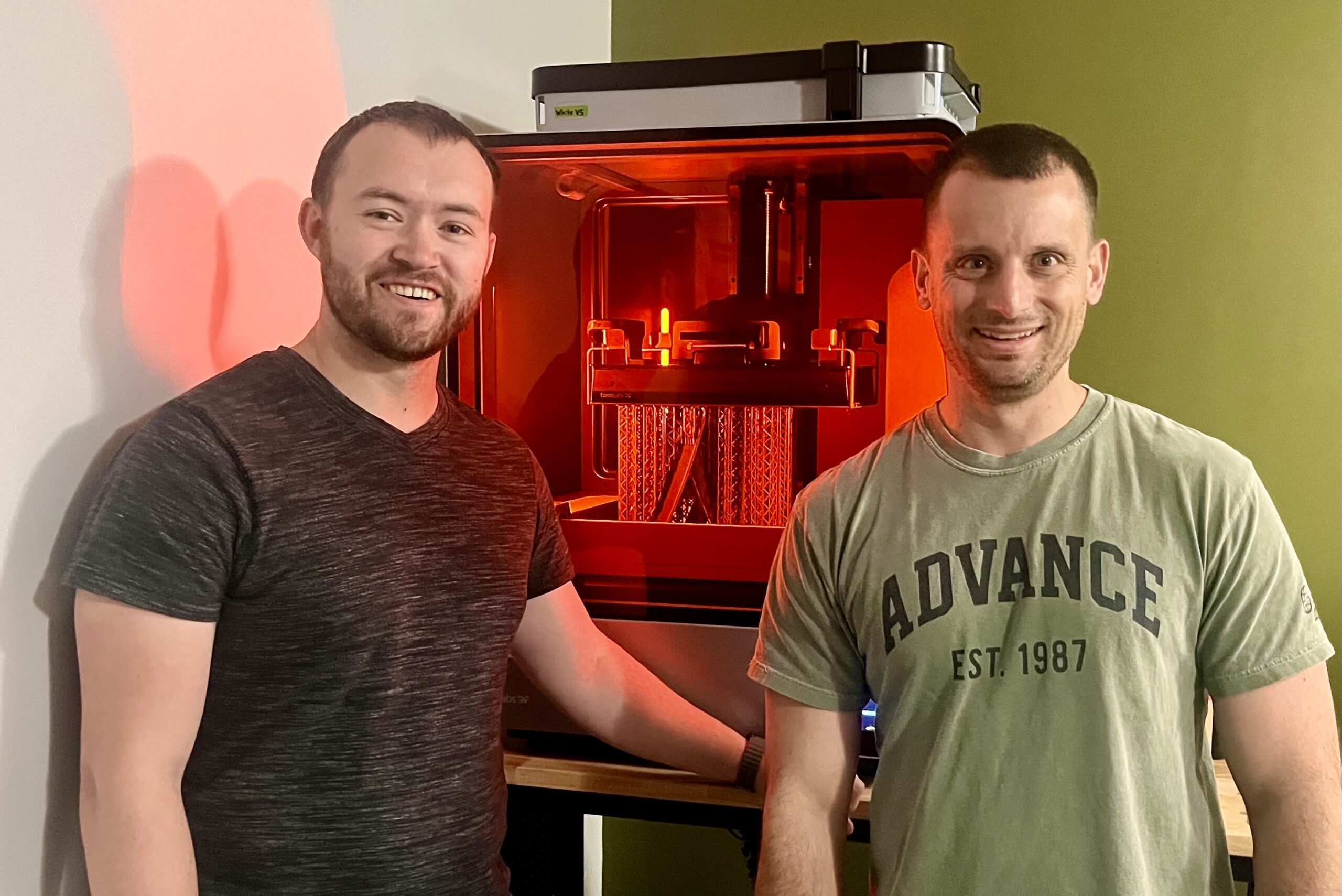
I worked at a great, very capable machine shop for 5+ years as a mechanical design engineer. During that time, I noticed a lot of ways that additive manufacturing can improve operations, reduce internal costs, and open up new opportunities for a CNC shop. Here’s what I learned about what Additive Manufacturing can do in a CNC shop setting:
1. Reduce the Cost of Custom Machining Fixtures
Machining fixtures are essential for holding parts securely and consistently during manufacturing. But designing and producing a custom fixture can be expensive, especially when it involves complicated geometry or only a one-off use.
3D printing offers a way to produce custom fixtures without the time and expense of machining them from scratch.
At Wolfpack Workshop, I’ve designed and produced several types of fixtures for CNC shops, including:
- Machining fixtures: Custom holders that position and secure parts during machining operations.
- Inspection fixtures: Tools that hold parts in a repeatable position for dimensional inspection.
- Laser-marking fixtures: Custom holders that keep parts properly aligned during laser marking.
These fixtures don’t necessarily need to be made from metal. Depending on the application, a durable 3D printed material can provide the rigidity and stability needed to hold a part in place.
I work with CNC shops to design and manufacture fixtures, without tying up a CNC machine that could be producing revenue-generating parts.
2. Streamline CMM Inspection Program Development
Coordinate measuring machines (CMMs) are essential for verifying part dimensions and maintaining quality control.
In my years of experience working as a design engineer at a CNC shop, I noticed this way that operations can be streamlined:
In a lot of projects, the shop needs a physical first article before it can verify the CMM program. That means the shop may have to go through the whole programming process before it can test the inspection routine. This slows down production and lead times.
High-resolution SLA 3D printing a first article can help a CNC shop validate their CMM inspection program before the first machined part is ready.
A 3D printed version of the part can be used to check probe access, fixture positioning, and parts of the inspection sequence. This gives the team an opportunity to identify potential issues, and troubleshoot the inspection workflow much earlier in the process.
For a project that has complex geometry, this can be a very useful way to reduce delays during the inspection process.
3. Improve Shop Organization with 3D Printed 5S Solutions
A well-organized shop makes it easier for team members to find tools, handle/transport parts, and stay efficient. We all know that, and we’ve all experienced what it’s like when a shop is NOT well organized.
Additive manufacturing is a great way to quickly design and manufacture custom organization systems.
Some examples include:
- Custom shadow boards: Organize tools in designated locations and make it easier to identify missing items.
- Gauge organizers: Store thread gauges, pin gauges, gauge blocks, and other inspection tools in labelled, easy-to-access holders.
- Part transport trays: Keep small parts organized and protected while they’re being moved between workstations.
- Tool storage inserts: Create custom compartments for tools and accessories that don’t fit standard organizers.
These solutions can be designed around the exact dimensions of your tools and workspaces.
Rather than buying a generic organizer and trying to make it work, you can create a system that fits the way your shop actually operates.
And because 3D printing doesn’t require traditional tooling, these organizers can be produced in small quantities and modified as your needs change.
4. Take on Customer Projects That Are Too Expensive to Machine
Sometimes a customer brings a CNC shop a part that is technically possible to machine, but doesn’t make sense financially to manufacture by machining.
The part might be too complex, the quantity might be too low, or the programming and setup costs might be too high relative to the value of the job.
Instead of turning the customer away, a CNC shop can outsource the project to an additive manufacturing partner (provided that the use case of the part works for AM).
At Wolfpack Workshop, I’ve worked with machine shops that have brought me projects from a good, returning customer that they didn’t want to lose. The part in question was a good fit for additive manufacturing, and the processes involved with machining would have been too expensive relatively.
By redesigning those parts for additive manufacturing, I’ve been able to produce them for a fraction of what it would have cost to design and manufacture them through CNC machining.
This gives the CNC shop another option when a customer brings a project that isn’t a perfect fit for the shop’s normal operations. It also allows the shop to maintain the relationship instead of sending that customer somewhere else.
5. Offer Prototypes Before Committing to CNC Machining
Not every part needs to be machined from the beginning. When a customer is developing a new product or refining an existing design, it can be expensive to jump straight into CNC production.
A design change might require new programming, additional setup, or another round of machining.
3D printing is a great way to test a design before investing in the final machined part.
A prototype can help a customer evaluate whether components fit together correctly, whether the part’s geometry works in application, and whether any design changes are needed before machining.
Once the design is completely finalized, the customer can move forward with CNC machining for the finished part.
This approach (having a trained mechanical engineer manufacture a high-precision SLA-printed prototype) allows the shop to support more of the customer’s development process, and become a “one-stop shop” for design and manufacturing.
6. Produce Functional Parts That Are Difficult/Expensive to Machine
Some jobs are simply better suited to additive manufacturing than CNC milling.
Complex geometry, intricate features, and low volume can make some parts very expensive or impossible to machine. In situations like this (provided the stress on the part is suitable), 3D printing, especially in industrial Tough Resins, can be a better option.
SLA printing with engineering-grade materials, like the Formlabs Tough Resins that I use at Wolfpack Workshop, can be useful for parts that need a combination of high precision, durability, flexibility, toughness, and good functional performance.
Some good applications:
- Custom brackets and mounts
- Functional housings and covers
- Custom tooling and fixtures
- Low-volume components
- Complex parts that would require extensive (and expensive!) machining
Of course, not every part is a good fit for 3D printing. Material requirements, temperature, load, tolerance, and production quantities all matter, and are a part of the process when I’m advising a shop or customer on what manufacturing method is best for their project.
7. Expand Your Capabilities Without Investing in More Equipment
CNC shops typically specialize in one thing– CNC machining. However, I’ve seen that a shop can become a one-stop manufacturing hub by opening themselves up to working with vendors who specialize in other manufacturing methods.
Investing in new equipment opens up new opportunities, but it also comes with a big upfront cost, maintenance requirements, a lot of training, and years of trying and failing before becoming a true expert on the said machine.
Outsourcing additive manufacturing is a great way for a shop to expand its capabilities, without needing to invest in expensive equipment and the training that is needed to operate industrial 3D printers.
How Wolfpack Workshop Supports CNC Machine Shops
I started Wolfpack Workshop to help companies solve manufacturing problems through engineering, design, and 3D printing.
A lot of my work is with CNC shops who need help with projects, but those projects aren’t a perfect fit for their existing capabilities.
Sometimes I design a custom fixtures to make a machining operation easier. Other times, I create and manufacture a prototype before a part goes into production. Quite often, I use my industrial 3D printers and engineering materials to manufacture parts that are would be too expensive to machine.
My goal is to help CNC shops keep more customer projects, reduce internal costs, improve ease of operations and organization, and expand what they’re able to offer without having to invest in new equipment.
Have a project for me?
If any of the above resonates with you, or you see an opportunity that additive manufacturing could help with your CNC shop’s operations, I’d love to work with you!


Leave a Reply