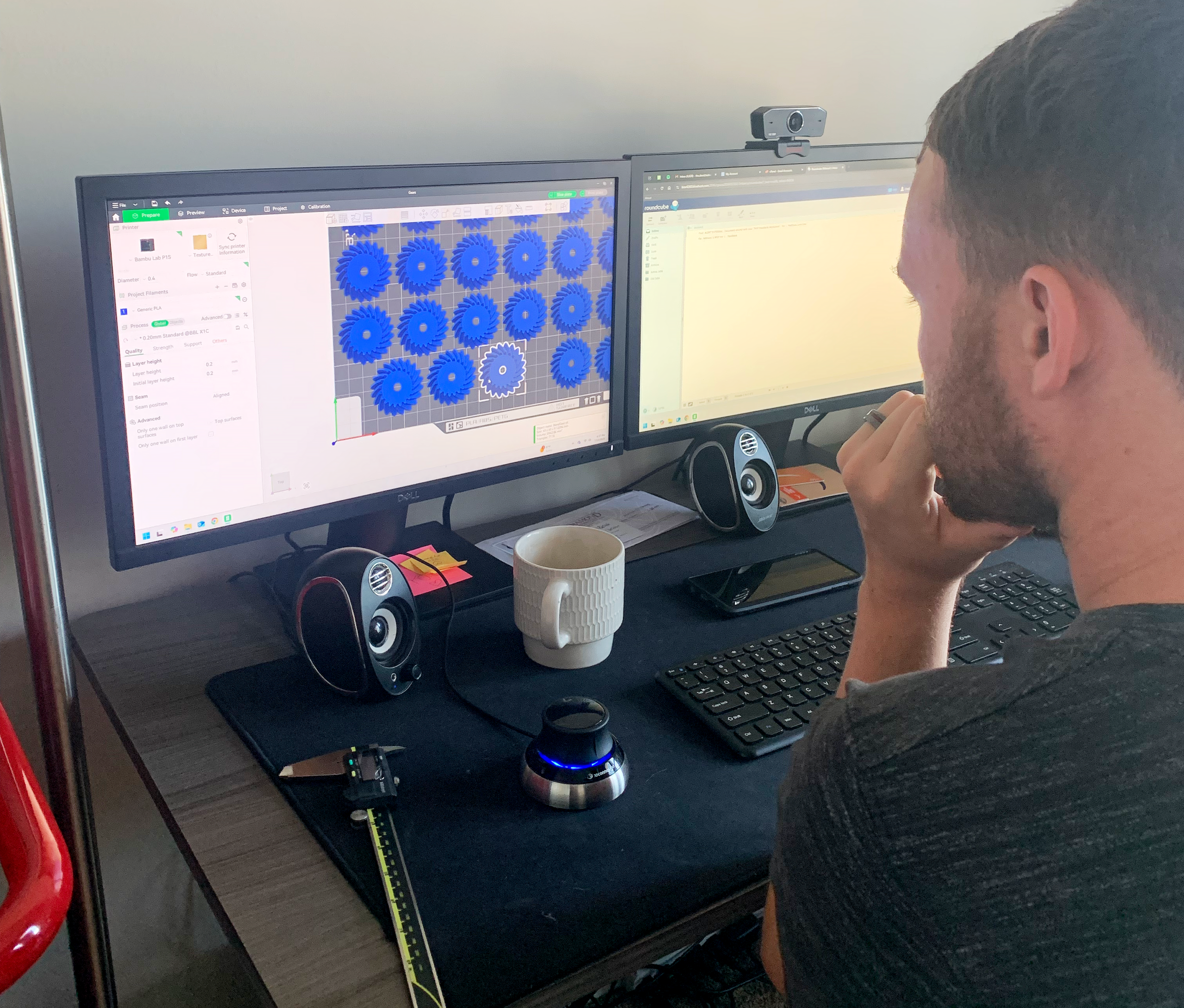
Engineering and 3D printing work best when they’re treated as a single process, not two separate steps. At Wolfpack Workshop in Columbus, Ohio, we approach every project with the end manufacturing method in mind from the very first sketch. This mindset allows us to design parts that aren’t just printable, but stronger, faster to produce, and more cost-effective over time. For companies exploring engineering and 3D printing, understanding this workflow can make a huge difference in final part quality.
3D Printing is more than just Printing a CAD Model
One of the biggest misconceptions about 3D printing is that you can simply “print any CAD model.” In reality, good custom engineering considers layer orientation, load directions, material behavior, and real-world use conditions well before a printer is ever turned on. Engineering with 3D printing in mind allows features like supports, bridges, and special geometry to be designed directly into the part rather than added later as a workaround.
This approach becomes especially valuable when working on the 3D printed replacement parts that local manufacturers rely on to keep equipment running. Through our reverse engineering process, we can duplicate or redesign parts to outperform the original while maintaining drop-in compatibility.
Fine-Tuning for 3D Printing
A major advantage of sourcing a part by 3D printing is rapid iteration. Instead of committing to expensive tooling or long lead times, engineers can test multiple design revisions quickly. We often produce several versions of a part and refine it based on feedback before locking in a final design. This ensures that the final product meets both mechanical and operational requirements.
Material and Filament Selection
Material selection is another critical factor in engineering-focused 3D printing. Different filaments offer tradeoffs between strength, flexibility, chemical resistance, and temperature stability. Selecting the correct material early allows engineers to design around its properties, resulting in more reliable 3D printed parts that companies can confidently deploy in real environments.
Steps of a 3D Printing Workflow
For customers unfamiliar with the process, 3D printing-led engineering typically follows a clear workflow:
- Reverse engineering or custom design based on real-world needs
- Design optimization specifically for additive manufacturing
- Controlled production using validated print settings
This process ensures that the final part design isn’t just printable, but it’s also dependable.
We regularly share behind-the-scenes looks at this workflow on our LinkedIn page. Check out our real examples of factory parts, replacement components, and design revisions. We cover topics like material selection, 3D printing insights, and when 3D printing outperforms traditional manufacturing.
Why Design for 3D Printing?
For businesses searching for engineering and 3D printing solutions, the biggest takeaway is this: the best results come from designing for the process, not adapting to it afterward. Whether the goal is a one-off prototype or a production-ready replacement component, thoughtful engineering makes 3D printing a powerful manufacturing tool.
At Wolfpack Workshop in Columbus, Ohio, we specialize in custom engineering, reverse engineering projects, and producing durable, functional parts through additive manufacturing. If you’re exploring a new part, replacing a broken one, or just curious about whether 3D printing is the right fit, we’re always happy to talk through the process.