
I spent some time the other day teaching myself something new.
I often talk about how my new SLA machine creates “injection mold quality parts” and competes with injection molding in a lot of key metrics.
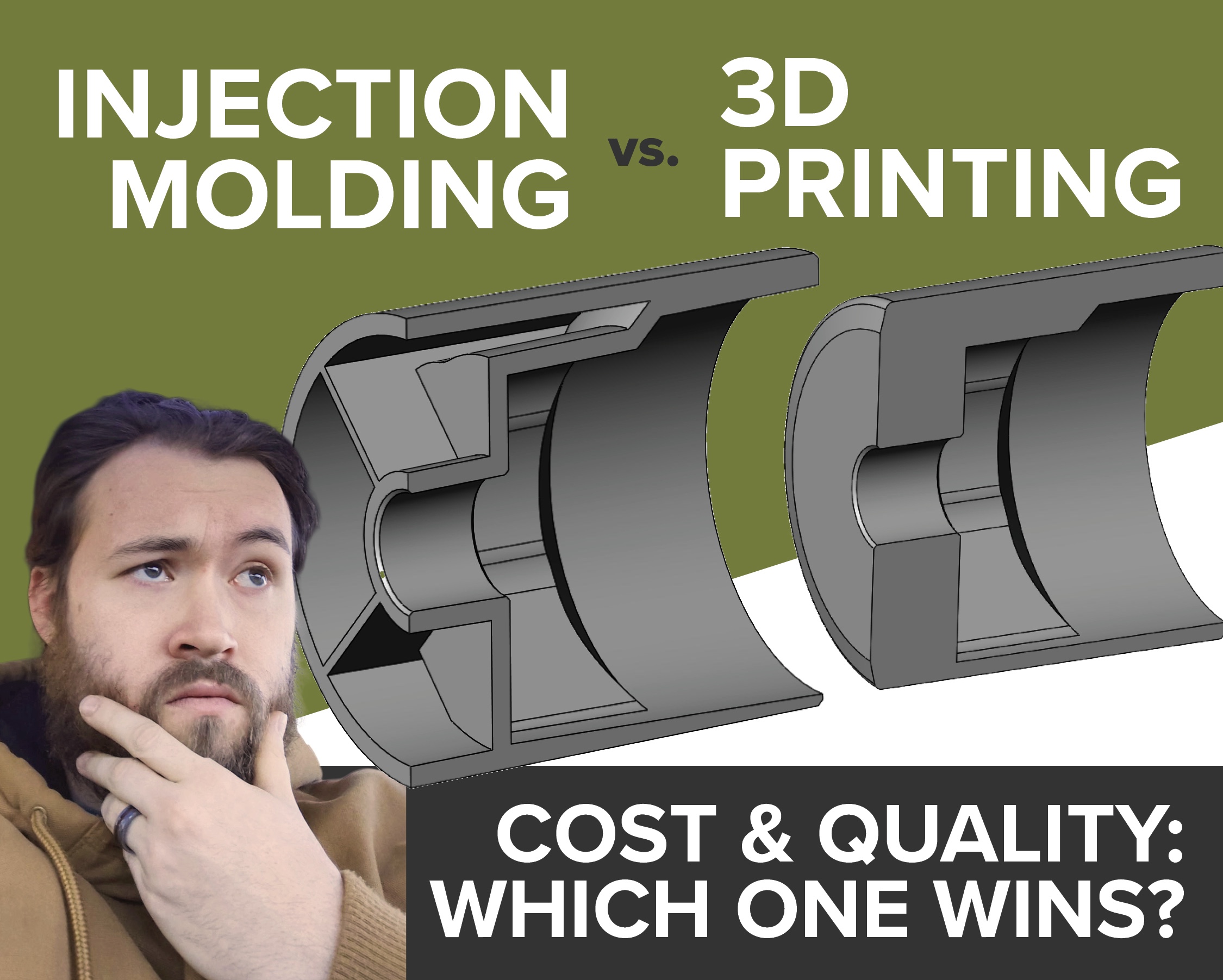
I decided to learn how to design a part for the injection molding process. I selected an old model that we quoted for 3D printing, but never manufactured, to convert into an injection molded design. I selected this part in particular because the quantity was on the higher side for 3D printing. 2,500 pc. to be exact.
The goal of the experiment: compare the pricing between my old 3D printing quote and the automatic injection molding quoting tool from Protolabs. Below are some of the things that I learned.
DESIGNING FOR INJECTION MOLDING
– Injection molded parts should have consistent wall thicknesses that are somewhat thin. So the first change I had to make to the model, was to shell out a bunch of the material to achieve this.
– Injection molded parts need to have drafted (or tapered) walls to allow for easy demolding. So I drafted all of the walls that were perpendicular to the mold seam.
– In injection molding, undercuts should be kept to a minimum. These tend to rapidly increase the complexity of the mold and the price of the part. This particular piece didn’t have any in the first place, so I didn’t have to do anything to optimize for this.
After converting my model to a design optimized for injection molding, I uploaded it to the automatic quoting tool I mentioned earlier. Turns out, for a quantity of 2,500 of this part, injection molding is cheaper by about $1/pc.
3D Printing vs. Injection Molding – Comparison
– Using the thin walls will decrease overall part strength. This may be a major decision-making factor when selecting the manufacturing method between 3D printing and injection molding.
– The geometric limitations of injection molding (such as limited undercuts and the drafted walls) can also limit functionality.
Through this experiment, I learned a lot more about the process of injection mold design and production. I learned about its strengths and its limitations, especially compared to 3D printing. I will use this knowledge in the future when narrowing in on the best manufacturing method for new projects!


